Everyone tells you to dream big.
Set audacious goals. Go all in. Make a massive change.
But here’s what they don’t tell you:
Big dreams without small steps lead to burnout, not breakthroughs.
If you’ve ever quit something because it felt too hard, too overwhelming, or too much to maintain, the problem wasn’t your motivation. It was the size of the step you tried to take.
And if you’re feeling your ‘New Year, New You’ energy starting to fade, you’re not alone. Whether you started in January or jumped in mid-year, that wave of motivation doesn’t last forever, and that’s okay. This is exactly the moment when most people either push harder… or give up entirely.
There’s a third option.
The question isn’t whether you should act—it’s how to start small when everything feels too big. And that third option starts small.

Somewhere along the way, we learned that small meant weak.
That if we weren’t making dramatic changes, we weren’t trying hard enough.
So we wait.
We wait until we have more time. More energy. More clarity. More motivation.
We wait for the “right moment” to do it properly.
But perfectionism has a sneaky way of disguising itself as preparation.
Small isn’t weak. Small is strategic.
Starting small lowers resistance. It makes action possible. And most importantly, it helps rebuild trust in yourself.

Starting small isn’t just feel-good advice. It’s backed by psychology.
Small actions:
When something feels doable, your brain is far more likely to cooperate. And once you start showing up consistently, even in small ways, you begin to rebuild self-trust.
That trust compounds faster than motivation ever could.
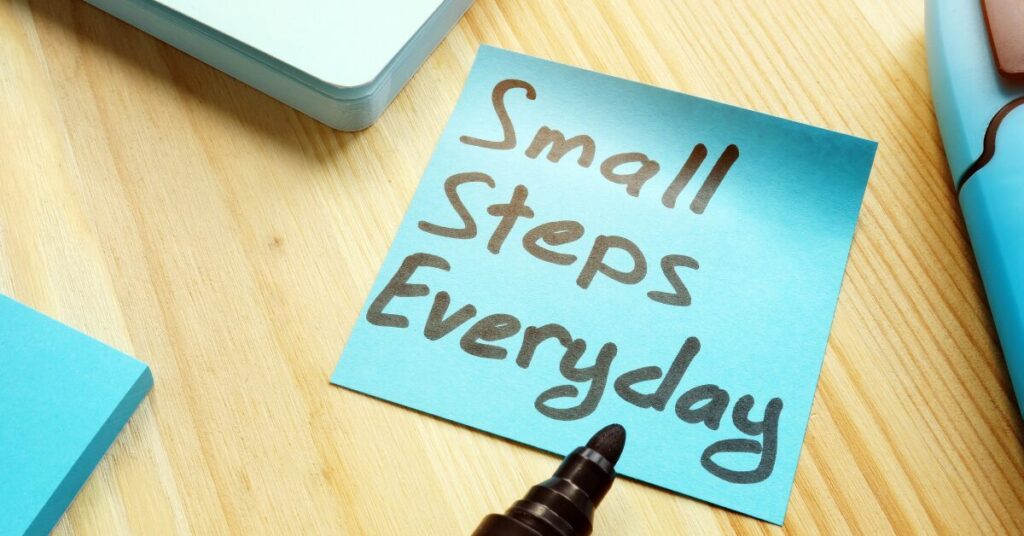
Big transformations don’t require big gestures. They require small, consistent actions repeated over time.

I used to think starting small meant I wasn’t serious enough.
I’d set big goals, make big plans, and expect myself to maintain big momentum. And when I couldn’t, I assumed something was wrong with me.
What I didn’t realize was that I was asking too much of myself too fast.
Everything that’s lasted in my life, habits, routines, even this work – started small. Not because I lacked ambition, but because small was sustainable.
And sustainability is what actually creates change.
If “start small” has ever felt vague or unhelpful, this is where clarity comes in.
Before taking action, ask yourself these three questions:
1. What’s the smallest version of this?
Break the goal down until it feels almost too easy.
2. Can I do this today?
If the answer is no, it’s still too big. Make it smaller.
3. Can I repeat this tomorrow?
Consistency matters more than intensity. If you can’t repeat it, adjust it.
This isn’t about lowering standards.
It’s about setting yourself up to succeed.
Here are examples of small actions that create big change:
The goal isn’t to do everything.
It’s to do something, and keep doing it.
This is one of the most common objections, and it makes sense.
You might be thinking:
Here’s the truth: small steps compound faster than you think. And they’re sustainable, which means they actually last.
Small is a big change, distributed over time.
You’re not building a house of cards.
You’re laying a foundation.
Pause for a moment.
What’s one area of your life where you’ve been waiting to feel “ready”?
What’s the smallest version of that first step?
Write it down.
That’s not insignificant.
That’s powerful.

Momentum isn’t built through intensity.
It’s built through repetition.
One small step leads to another. Confidence grows. Resistance fades. And before you realize it, the thing that once felt impossible feels natural.
Starting small isn’t settling. It’s how real change begins.
You don’t need to overhaul your life.
You don’t need perfect conditions.
You don’t need a detailed plan.
You need to take the next right step, and then the one after that.
If you want to go deeper, my post Time Management Mastery: A Practical Guide for Success breaks down practical strategies for managing your time when you’re starting small, including how to prioritize without overwhelm.
And if this resonates, I’d love to stay connected.
Join the Life Unscripted newsletter below for weekly insights on building a life that actually feels like yours, one small, intentional step at a time.
Your future self will thank you for the small step you take today.

We’re glad you’re here. Expect honest insights, helpful tools, and a community that grows right alongside you.