

You’ve been doing the things.
You’re drinking more water. Getting more sleep. Trying to move your body. Maybe you even bought the journal, lit the candle, and told yourself this time you’re really going to stay consistent.
And yet… something still feels off.
You’re not falling apart. You’re still showing up. Still handling your responsibilities. Still being the person everyone expects you to be.
But underneath all of that?
You’re tired in a way that rest doesn’t fix.
You’re overwhelmed in a way you can’t quite explain.
You’re doing everything “right”… and still don’t feel okay.
That disconnect isn’t random. And it’s not because you need to try harder.
It’s because most of what we’ve been taught about self-care is missing the part that actually holds everything together: emotional self care.

Most self-care advice focuses on what you can see.
Your habits.
Your routines.
Your physical well-being.
And yes, those things matter.
But here’s the part that gets overlooked:
You can take care of your body and still feel emotionally drained.
You can build a routine and still feel mentally scattered.
You can check every box and still feel like something isn’t clicking.
Because self-care isn’t just about what you do.
It’s about what’s happening underneath while you’re doing it.
Your thoughts.
Your emotional state.
The way you process stress, pressure, and everything you carry quietly.
That’s the layer most people skip, not because they don’t care, but because no one really taught them how to care for it.
And without that layer?
Everything else starts to feel like maintenance instead of support.
The mind doesn’t get a rest day just because you took one.

Picture this for a second.
She wakes up early. Gets ready. Maybe even squeezes in a workout. She’s organized, productive, and dependable. People would probably describe her as “having it together.”
But internally?
She’s running through a constant loop of thoughts she hasn’t had time to process — and if that sounds familiar, learning how to stop overthinking when your mindset is off can be a real turning point.
She’s holding onto conversations that didn’t sit right.
She’s pushing past emotions because there’s no space to deal with them.
She’s functioning, but not actually okay.
And the hardest part?
There’s no clear signal telling her to stop. No obvious breakdown. Just a slow, steady feeling of being off.
If that feels familiar, you’re not alone, and you’re not doing anything wrong.
You’re just trying to build a life on top of an emotional foundation that hasn’t been supported yet.
Physical self-care is visible. It’s measurable. It feels productive.
You can track your steps.
You can see your routine.
You can check it off a list.
Mental and emotional self-care?
That’s quieter. Less structured. Harder to define.
You can’t always measure it.
You can’t always explain it.
And because of that, it’s often the first thing people ignore.
But here’s the truth: Your emotional state affects everything, a connection that research on emotional regulation and mental health consistently confirms.
How you show up.
How you respond.
How you make decisions.
How you connect with people.
How you experience your own life.
If your inner world is overwhelmed, your outer efforts will always feel heavier than they should.
That doesn’t mean your routines are pointless.
It means they need something deeper to stand on.
You don’t need another habit. You need to actually check in with yourself.

Let’s make this simple, because this doesn’t need to be complicated to be effective.
Emotional self care isn’t about fixing everything. It’s about creating space for what’s already there.
Here’s a framework you can come back to, especially on the days when you feel off but can’t explain why.
1. Awareness, Noticing Without Rushing Past It
Before anything can shift, you have to notice what’s going on.
Not the polished version. Not the “I’m fine.”
The real version.
Am I overwhelmed?
Am I irritated?
Am I anxious?
Am I just tired, or is there something underneath that?
This isn’t about overanalyzing. It’s about slowing down long enough to acknowledge what’s already present.
Most of us skip this step because we’ve trained ourselves to keep moving.
But awareness is where everything starts.
2. Processing, Letting It Move Instead of Storing It
This is the part people avoid the most.
Because processing emotions doesn’t look productive. It doesn’t check a box. And sometimes, it feels uncomfortable.
But unprocessed emotions don’t disappear. They build. They linger. They show up in other ways, such as stress, tension, irritability, and burnout, patterns that building habits to conquer stress and anxiety can help you manage.
Processing doesn’t have to be complicated.
It can look like:
You’re not trying to fix the emotion.
You’re giving it somewhere to go.
3. Regulation, Supporting Yourself Through It
Once you’re aware and you’ve allowed space for what you’re feeling, the next step is support.
Not suppression. Not avoidance. Support.
What do I need right now?
Not what should I do, but what do I actually need?
Sometimes that’s rest.
Sometimes it’s boundaries.
Sometimes it’s stepping away from something that’s draining you.
Sometimes it’s doing something grounding and simple.
This is where emotional self-care becomes practical.
It’s not about doing more.
It’s about responding differently.
If this is resonating, pause here for a second before moving on.
Not to scroll. Not to move to the next thing.
Just pause.
Because real change doesn’t happen when you collect more information.
It happens when you actually sit with what you’re noticing.
Save this, you’ll want to come back to it.

This is for real-life days, the ones where you don’t have the energy for a full routine or deep reflection. Not a full reset. Just a small shift.
That’s it.
No pressure to do it perfectly.
No expectation to “fix” everything.
Just a small moment of honesty and support.
Because emotional self-care isn’t built in big, dramatic changes. It’s built in small, consistent check-ins.
It’s built in small, consistent check-ins.
If this feels unfamiliar, there’s a reason.
Most of us were taught how to function, not how to feel.
We learned how to push through.
How to stay busy.
How to handle things on the surface.
But no one really taught us how to sit with ourselves.
How to process what we’re carrying.
How to take care of the parts of us that aren’t visible.
So if this feels awkward or unclear, that doesn’t mean you’re doing it wrong.
It means you’re learning something new.
And that matters more than getting it perfect.
Emotional self care isn’t soft. It’s the hardest, most necessary work you’ll ever do.
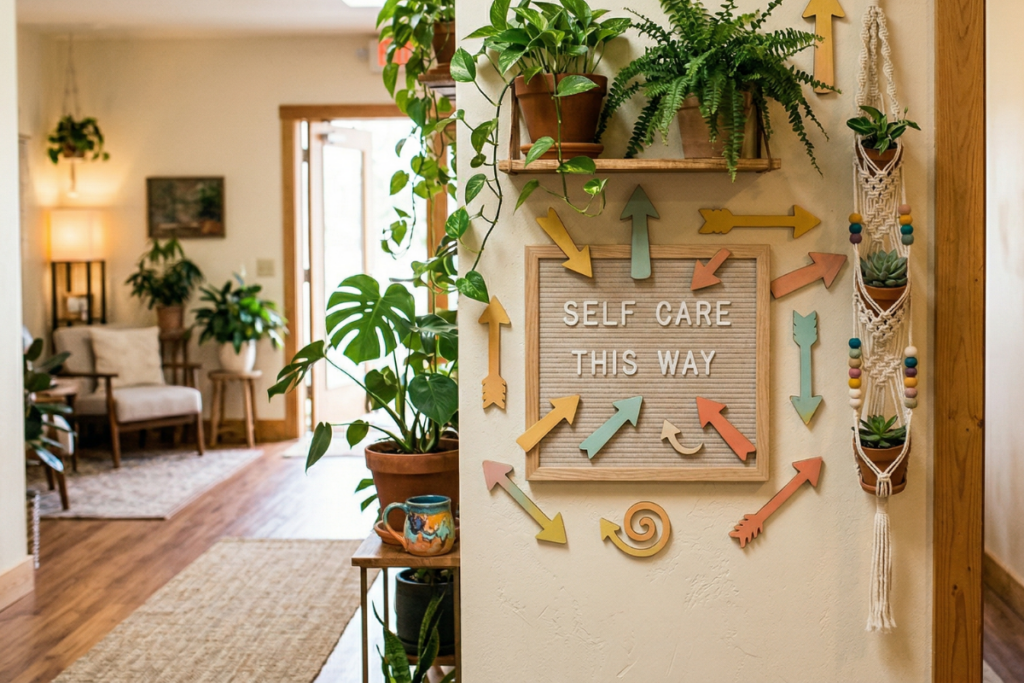
When you start taking care of your mind and emotions, things begin to shift.
Not overnight. Not all at once.
But gradually.
You respond instead of react.
You feel more grounded in your decisions.
You stop carrying things longer than you need to.
You create space between what happens and how it affects you.
And suddenly, all those other self-care habits?
They start to work the way they were supposed to.
Because now they’re supported by something real.
This isn’t about becoming a different person.
It’s about becoming more aware, more honest, and more supported in your own life.
And this?
This is just the beginning of that work.
Before you move on from this, take a second to check in.
What have I been carrying that I haven’t actually acknowledged yet?
Don’t rush the answer.
Don’t try to make it sound good.
Just notice what comes up.
Because the moment you start paying attention to your inner world is the moment things begin to shift.
And you don’t have to do it all at once.
You just have to start.
If this opened something up for you, that’s a good thing.
It means you’re paying attention differently, and that’s where real change begins.
If you want more conversations like this, the honest kind, the grounded kind, the ones that actually meet you where you are, join the newsletter.
This is the beginning of what it looks like to care for yourself at the level you actually deserve.
And you don’t have to figure it out alone.

We’re glad you’re here. Expect honest insights, helpful tools, and a community that grows right alongside you.